The future of snowmaking in a drying world
Curious Nature

Chris Dillman/Vail Daily
Correction: The original version of this column incorrectly stated that “most of the energy” for snowmaking comes from fossil fuels. Locally, resorts that receive their electricity from Holy Cross Energy including Vail, Beaver Creek, and Aspen, get 80-90% of their power from renewable sources. Vail Resorts also achieved 100% renewable electricity for the second consecutive year and says it’s ahead of schedule for zero net emissions by 2030.
Nothing quite compares to those mornings when you wake up and see the mountains around you blanketed in white — but how much of what you see came from a machine?
As global temperatures increase, Colorado’s multi-billion dollar ski industry — the largest in the country — increasingly turns to “artificial” snow to keep the people shredding. Although this keeps snow on the mountains, snowmaking comes with its own consequences.
The ingredients of machine-made snow and naturally-forming snow are the same, although the output, when examined closely, looks and feels very different. Natural snow forms in a relatively slow process. In the clouds, tiny droplets of water freeze around a nucleus of dust or dirt, taking about an hour to form unique, six-sided snowflakes.

Snowmaking machines imitate this process by shooting out compressed water droplets mixed with pressurized air. These droplets then freeze in the air and fall to the ground. Artificial snow freezes in a matter of seconds, creating compact pellets rather than our renowned Colorado powder.
This snow may be less pretty, but its density increases the snowpack’s durability, helping it stick to the slopes through the freeze-and-thaw cycles. Snowmaking machines still need cold temperatures to form snow, so as our winters get warmer and shorter, snowmaking is not going to be our fix-all solution, especially when you factor in the potential environmental costs.

Support Local Journalism
Ironically, this attempt to adapt exacerbates the root cause. Snowmaking represents up to 50% of the total energy consumed by ski resorts in the United States.
It is water, the vital ingredient in snow that is of greatest concern when it comes to snowmaking in Colorado. Water has been dwindling in the West over the last 22 years. Widespread declining snowpack has led to cumulatively less water running into our ecosystems, including the Colorado River, which supplies over 40 million people with water.
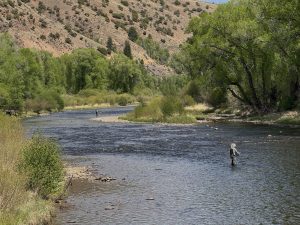
In Colorado, water access and quantity are determined by water rights, which are determined by seniority. Simply put, those who have the oldest water rights have first priority, and many of the most senior rights holders in Colorado lie along the Western Slope in Glenwood and Gypsum — downstream from Eagle County. Ultimately and luckily for us, this limits the ability of those upstream or in the Front Range to divert water, keeping it flowing West through the Eagle River. This is important given that Vail and Beaver Creek get most of their water for snowmaking from the Eagle River.
Ski areas like Vail operate under a U.S. Forest Service special-use permit, which requires ski areas to have sufficient water to operate a ski area and sustain it in the future. This means maintaining adequate water rights or access to sufficient water quantity. Due to their location, Vail and Beaver Creek seem to meet these requirements. However, resorts closer to the Front Range such as Breckenridge or Keystone rely on “borrowing” their water from Denver Water.
What matters in your community, delivered daily.
Sign up for our morning newsletter at VailDaily.com/newsletter
When it comes to snowmaking, the thought is that all the water used to make snow will eventually return to the watershed come springtime, ensuring water continues to run West. However, amid a drying world, increasing water restrictions and increasing research that suggests a significant part of this water is lost due to sublimation or evaporation, the snowmaking industry may be in trouble — and with it, our warming ski resorts.
Bella Whiting is a Naturalist at Walking Mountains Science Center who loves skiing and the taste of snowflakes on her tongue.